
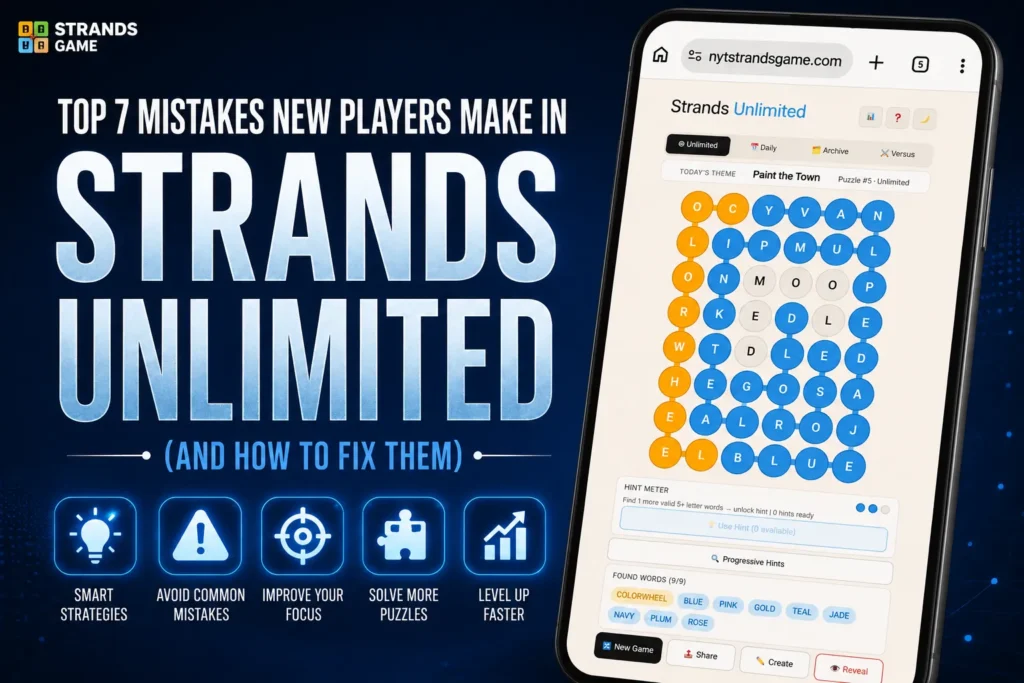
Top 7 Mistakes New Players Make in Strands Unlimited
Most new players lose a perfectly solvable puzzle in the first two minutes, not the last two. They skip the theme clue, ignore everything on the grid except theme words, burn a hint the moment they feel stuck, and never build the scanning habits that make Strands Unlimited click. None of these are vocabulary problems. They’re approach problems, and every one of them is fixable in your very next puzzle.
Here’s the quick version, if you just want the fixes:
| Mistake | Quick Fix |
|---|---|
| Diving into letters without reading the theme | Read the theme clue twice before touching a single tile |
| Not hunting the spangram first | Spend the first minute tracing edge-to-edge paths before chasing theme words |
| Ignoring bonus words | Actively spell any 5+ letter non-theme word you spot — three of them earns one hint |
| Using a hint the moment you stall | Give the board a real 3 minutes before spending a hint, since one hint fully reveals a word’s path |
| Searching the grid randomly | Scan the edges and corners first, then work inward |
| Forgetting diagonals exist | Letters connect in up to eight directions, not just up/down/left/right |
| Playing every mode the same way | Match your pace and hint use to whichever mode you’re in — Unlimited, Daily, Archive, or Versus |
Now the reasoning behind each one, because understanding why a mistake costs you is what actually makes the fix stick.
Mistake 1: Diving Into Letters Before Reading the Theme
Every Strands Unlimited puzzle opens with a short theme clue at the top of the board — something like “Coffee Hour” or “Under the Sea.” New players routinely skip past it and start tapping letters immediately, hoping something clicks. It rarely does efficiently. Without the theme in mind, you end up spelling random valid words that have nothing to do with the puzzle, which wastes time and, worse, can make you second-guess actual theme words because you don’t recognize them as relevant.
The theme is a mental head start. If the clue is “Sweet Treats,” your brain should already be running through cake, candy, and cookie before you’ve traced a single letter. That primed vocabulary makes theme words jump out at you instead of blending into the noise.
The fix: read the theme twice before you touch the grid. Spend ten seconds actively brainstorming words that fit it. That ten-second investment consistently pays for itself in the first minute of solving.
Mistake 2: Not Hunting the Spangram First
The spangram is the one word on the board that stretches across two opposite edges — top to bottom, or left to right — and it directly describes the puzzle’s theme. New players tend to ignore it early and go hunting for smaller, easier-looking theme words instead, which means they’re solving the puzzle without the one piece of information that makes everything else easier.
Once you know the spangram, you’re not guessing at the theme’s angle anymore — you’re confirming it. A theme labeled “World Tour” could mean countries, landmarks, or languages; the spangram tells you which, and the remaining theme words stop being blind guesses.
The fix: before chasing individual theme words, spend the first minute specifically looking for long letter chains that start or end near a corner or edge. Edge tiles connect in fewer directions than center tiles, which makes their word paths easier to spot — that’s exactly why the spangram tends to reveal itself there first if you’re actually looking.
Mistake 3: Ignoring Bonus Words Entirely
New players lock in so hard on theme words that they walk right past obvious 5+ letter words sitting in plain sight — ordinary words like HOUSE, PLATE, or STORM that have nothing to do with the theme. In Strands Unlimited, these bonus words are the only way to fill your hint meter. Find three of them, and you unlock one hint. Skip them, and you finish the entire puzzle without ever earning help, even on a board where you’d genuinely benefit from it.
This is the real reason hints feel “rare” to a lot of new players. They’re not scarce — they’re simply not being earned, because nobody’s looking for them.
The fix: while scanning for theme words, keep part of your attention on anything that reads as a normal English word regardless of theme relevance. If you’re stuck, stop hunting theme words for a moment and deliberately hunt bonus words instead. You’re not solving the puzzle in that moment — you’re banking a hint you’ll want later.
Mistake 4: Spending a Hint the Moment You Stall
This is the mistake that costs satisfaction more than time. A player gets stuck for 90 seconds, taps the hint button out of impatience, and watches the game light up the entire path of a theme word for them — because in Strands Unlimited, one earned hint fully reveals where a remaining theme word lives on the board. That’s a lot of help for one impatient tap.
The first two or three theme words on almost any puzzle are the easiest ones to find without assistance — they tend to be shorter, use more common letters, and sit in less cluttered parts of the grid. Once you’ve found a couple on your own, the remaining letters start suggesting patterns, often without needing a hint at all. Spending a hint before that pattern recognition kicks in trades away a resource on a problem that was about to solve itself.
The fix: hold off on hints for the first three minutes of a puzzle, minimum. If a specific word is still resisting you after that — and you’ve already scanned the edges and corners around it — that’s a legitimate moment to spend a hint. Not before.
Mistake 5: Searching the Grid Randomly Instead of Systematically
Watch a new player’s eyes move across a Strands board and you’ll often see them jump around with no order — center, then a random edge, then back to the center. This eventually works, but it’s slow, and it means both theme words and bonus words get missed simply because a section of the grid was never properly scanned.
Systematic scanning — edges and corners first, then working inward row by row or column by column — reliably outperforms unstructured searching in grid-based word tasks. This isn’t specific to Strands; it shows up broadly in research on visual search and word-finding tasks, where methodical, ordered scanning tends to produce faster and more complete results than scattershot searching, largely because a fixed order guarantees full coverage of the grid instead of leaving blind spots your eye keeps skipping.
The fix: adopt a fixed scanning order and use it every puzzle — outer ring first, then inward. It feels slower and more deliberate at first, but it consistently finds more of the board’s words, theme and bonus alike, than jumping around does.
Mistake 6: Forgetting That Diagonals Count
This one is purely mechanical, but it trips up a surprising number of new players. Letters in Strands Unlimited connect in up to eight directions — horizontal, vertical, and both diagonals — not just the four cardinal directions people default to. A player convinced a word “doesn’t fit” is very often missing a diagonal connection between two letters that are, in fact, right next to each other.
The fix: whenever a word seems almost-but-not-quite traceable, explicitly check the diagonal neighbors of the letter where you’re stuck before deciding the word isn’t on the board. This single check resolves a meaningful share of “I know the word but the grid won’t let me trace it” moments.
Mistake 7: Playing Every Mode the Same Way
Strands Unlimited runs four core modes — Unlimited Mode, Daily Puzzle, Archive Mode, and Versus Mode — plus a separate Custom Puzzle Creator for building and sharing your own boards. The core mechanics stay identical across all of them: 5+ letter bonus words, three words per hint, one hint per full theme-word reveal. What should change is your pace and hint tolerance, and new players tend to treat every mode identically, either hoarding hints everywhere or spending them everywhere.
| Mode | How new players usually misplay it | Better approach |
|---|---|---|
| Unlimited Mode | Plays overly cautiously, as if hints were scarce | Use hints freely — it’s the lowest-stakes mode and the best place to build pattern-recognition instinct through repetition |
| Daily Puzzle | Either burns hints immediately or refuses to use any out of streak anxiety | Save hints for the last stubborn word or two; a hint-assisted solve still counts toward your streak |
| Archive Mode | Skips harder past puzzles instead of working through them | Use it to catch up on puzzles you missed, and don’t hesitate to use hints on genuinely tough older themes |
| Versus Mode | Hesitates to use hints out of pride and loses on time | With a 3-minute clock and points on the line, use hints aggressively — speed wins matches, not clean solves |
The fix: decide your hint strategy based on which mode you’re actually in, not out of habit. The rules don’t change between modes, but the right amount of patience does.
A Quick Self-Check Before Your Next Puzzle
Run through this in your head before opening a new grid — it takes ten seconds and catches most of the mistakes above before they happen:
- Have I actually read the theme clue, or did I jump straight to the letters?
- Am I spending the first minute hunting for the spangram, or guessing at smaller words instead?
- Am I keeping half an eye out for bonus words, or only looking for theme words?
- Have I given this stuck word at least three minutes before reaching for a hint?
- Am I scanning the grid in a fixed order, or jumping around based on where my eye lands?
- Have I checked diagonal neighbors before deciding a word “isn’t there”?
- Does my hint strategy actually match the mode I’m playing, or am I running the same routine regardless?
Any single “no” on that list points straight to which habit is worth fixing first.
Why These Mistakes Are Worth Fixing Early
None of these seven mistakes require a bigger vocabulary or faster fingers to fix — they’re all approach problems, which means they’re fixable starting with your very next puzzle. The pattern underneath all seven is the same: new players react to the grid instead of working it methodically. Reading the theme first, hunting the spangram early, banking bonus words on purpose, holding off on hints, scanning systematically, checking diagonals, and adapting to the mode you’re in are all versions of one shift — from reacting to planning.
That shift compounds. A player who fixes these habits doesn’t just solve today’s puzzle faster; they get measurably quicker at spotting theme words and bonus words in every puzzle after it, because deliberate, structured practice — the kind Unlimited Mode is built for, letting you run five or ten puzzles back to back — builds pattern recognition far faster than solving one puzzle a day ever could.
FAQ
What’s the single most common mistake new Strands Unlimited players make? Spending a hint within the first couple of minutes. Since one hint fully reveals a theme word’s path, using it before you’ve given the board a real chance trades away a strong resource on a problem that was often about to solve itself.
How do I earn hints faster as a new player? Actively look for bonus words — real English words of 5 or more letters that aren’t part of the theme — instead of waiting to stumble across them by accident. Three bonus words unlock one hint, and that’s the only way to earn one.
Should I look for the spangram before the theme words? Yes. The spangram spans two opposite edges of the grid and directly names the puzzle’s theme, which makes every remaining theme word easier to identify. Spend the first minute of a puzzle specifically hunting for it.
Do letters connect diagonally in Strands Unlimited? Yes. Letters can connect in up to eight directions, including both diagonals, not just up, down, left, and right. Forgetting this is a common reason a word that “should” be traceable seems to disappear.
What does a hint actually reveal in Strands Unlimited? A single hint lights up the full path of one remaining theme word on the board. It doesn’t hand you every answer in the puzzle, but it does fully solve whichever word you spend it on — which is exactly why timing matters more than most new players realize.
Should I play Daily Mode and Unlimited Mode the same way? No. Unlimited Mode has no streak or leaderboard pressure, so it’s the best place to spend hints freely and build instinct. Daily Mode rewards saving hints for the last stubborn word or two, since a hint-assisted solve still protects your streak without you giving up on the puzzle entirely.