
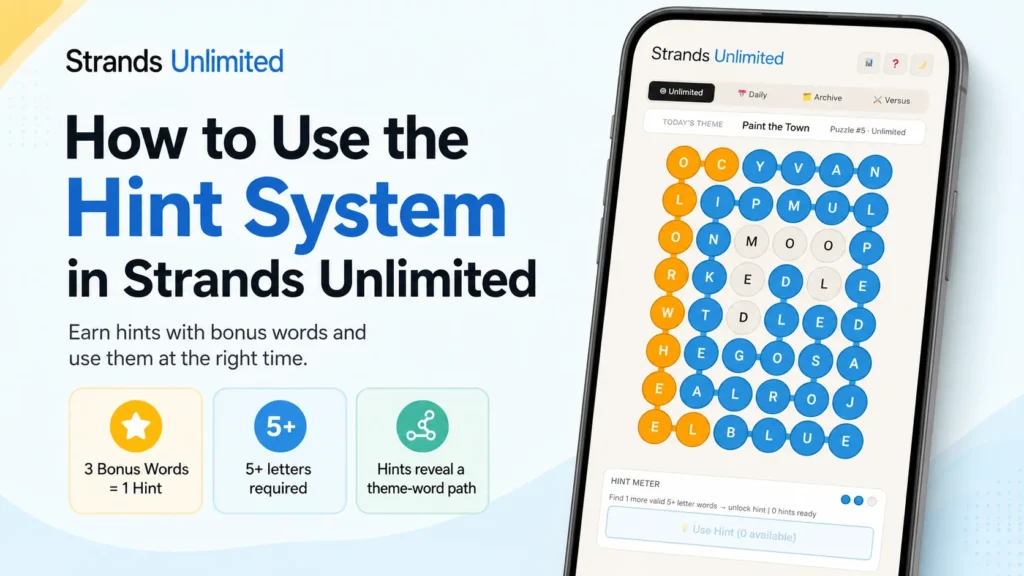
How to Use the Hint System in Strands Unlimited
Getting stuck is a normal part of playing Strands Unlimited. Sometimes, one hidden theme word can block your entire puzzle. That is where the hint system becomes useful.However, using a hint too early can reveal a word you could find yourself. Saving every hint can also waste time and create unnecessary frustration.
The smarter approach is to understand how hints work. You should earn them early and use them only when they offer real value. In Strands Unlimited, you earn one hint after finding three valid bonus words. Each bonus word must contain five or more connected letters. It must also be different from the puzzle’s theme answers.
When activated, a hint highlights the full path of one remaining theme word. You must still trace that path to complete the word. This guide explains how to earn hints, when to use them, and how to avoid wasting them.
How Do Strands Unlimited Hints Work?
You unlock one hint after finding three valid bonus words.A bonus word must:
- Contain at least five letters
- Be accepted by the game
- Use connected letters
- Not be a theme word
Letters can connect horizontally, vertically, diagonally, or through a mixed path. When you use a hint, the game highlights the complete path of one remaining theme word. It does not automatically submit the answer. You must follow the highlighted path and trace the word yourself.
What Is the Hint System in Strands Unlimited?
The hint system gives you help without making the puzzle too easy. You do not start each puzzle with unlimited assistance. You must first explore the grid and find extra words. These extra words are called bonus words. Bonus words do not complete the main puzzle. Instead, they fill your hint progress.
The basic process works like this:
- Read the puzzle theme.
- Search for connected words.
- Find three accepted bonus words.
- Unlock one hint.
- Use the hint when progress stops.
- Trace the highlighted theme word.
- Continue solving the puzzle.
This system rewards exploration. Even a word outside the theme can help you later.
How Do You Earn a Hint?
You earn one hint by finding three accepted bonus words. Each accepted bonus word fills one part of your hint meter.
The process is simple:
- First bonus word: one step toward a hint
- Second bonus word: two steps toward a hint
- Third bonus word: one hint unlocked
The three bonus words do not need to relate to each other. They only need to meet the game’s rules.
What Counts as a Bonus Word?
Requirement | Rule |
Minimum length | Five letters |
Word validity | Must be accepted by the game |
Letter connection | Every letter must touch the next |
Theme relationship | Must not be a theme answer |
Hint reward | Three bonus words unlock one hint |
A Bonus Word Must Contain at Least Five Letters
A four-letter word will not increase your hint progress. For example, “HAND” contains four letters. It may be a real English word, but it is too short. A word such as “HOUSE” contains five letters. It may count when its letters connect correctly. Always count the letters before tracing a possible bonus word. This prevents wasted attempts.
Every Letter Must Connect
Each new letter must touch the previous letter.
You can connect letters:
- Horizontally
- Vertically
- Diagonally
- Around corners
- Through curved paths
You cannot jump between distant parts of the grid.A valid word can change direction several times. It does not need to appear in a straight line.
The Word Must Be Accepted by the Game
Random letter combinations will not count. The word must be recognised by the game. Common nouns, verbs, and adjectives are usually easier to find. Some names, abbreviations, slang terms, and rare spellings may not be accepted. When a word fails, check its spelling and path. It may also be too short or part of the theme.
It Must Not Be a Theme Word
The answer is not automatically submitted. You must begin at the correct letter and follow the highlighted path. The game completes the word only after you trace it correctly. This gives you meaningful assistance while keeping you involved in the solve.
Can You Choose Which Word the Hint Reveals?
You cannot normally choose the exact theme word revealed by a hint.The game selects one remaining answer.
You may want help with the spangram. However, the hint may highlight a regular theme word instead.That can still be useful.Every solved word removes more uncertainty from the grid. The remaining unused letters may form clearer paths afterward.
Why Do Players Waste Hints?
Many players use hints after only a few seconds of difficulty.They stop scanning carefully and press the hint button immediately. The game may then reveal an easy word they could have found independently.Other players make the opposite mistake. They save every hint and spend too long staring at the same letters.
Common reasons for wasted hints include:
- Using help too early
- Ignoring the theme clue
- Missing diagonal connections
- Entering four-letter words
- Randomly swiping across the board
- Rechecking the same grid area
- Ignoring unused letters
- Saving help for too long
- Expecting the hint to complete the word automatically
A hint offers the most value after you have tried the main solving techniques.
When Should You Use a Hint?
Use a hint when focused searching no longer creates progress.
You may need one when:
- You have found several theme words.
- You have searched carefully for a few minutes.
- Only difficult answers remain.
- The theme contains unfamiliar vocabulary.
- You cannot identify the spangram.
- The unused letters form no clear word.
- You keep testing the same failed paths.
- You are playing under time pressure.
- The puzzle is becoming frustrating.
The goal is not to avoid every hint.
The goal is to use each hint when it can genuinely improve your solve.
Use a Hint After Scanning the Entire Grid
Before using help, examine the complete grid in a clear order.
Try this scanning process:
- Scan the top edge.
- Check the right edge.
- Scan the bottom edge.
- Check the left edge.
- Inspect all four corners.
- Search diagonally in both directions.
- Examine the centre.
- Review the unused letters.
This process stops you from repeatedly checking one small area.
It also makes hidden curves and diagonal word paths easier to notice
Use a Hint When Progress Completely Stops
A short pause does not always mean you are stuck.
You are genuinely stuck when several focused attempts produce nothing useful.
Possible signs include:
- You cannot form another theme word.
- Your bonus-word attempts keep failing.
- You no longer understand the theme.
- You keep returning to one letter group.
- You are guessing without a clear reason.
- You have stopped noticing new patterns.
At that point, a hint can restore momentum.
Use a Hint for Unfamiliar Themes
Some themes use common everyday vocabulary.
Other puzzles may include less familiar subjects, such as:
- Regional foods
- Scientific terms
- Music vocabulary
- Historic objects
- Technical equipment
- Unusual sports
- Rare plants
- Lesser-known animals
You cannot easily recognise a word you have never seen.
A hint can reveal an unfamiliar answer and clarify the theme. Study the word before moving forward.
That small step can help with similar puzzles later.
Use a Hint During Timed Play
Speed matters more during timed challenges. You may not have several minutes to inspect every possible path. Start by finding the easiest theme words. Collect natural bonus words while searching.Use available help when your progress slows enough to affect your result.
When Should You Save a Hint?
Save your hint while independent progress remains possible.
You should normally wait when:
- The puzzle has just started.
- You have not read the theme carefully.
- You have found only one theme word.
- You have not checked the edges.
- Several obvious paths remain.
- You are still finding bonus words.
- You are close to recognising the spangram.
- New answers are appearing regularly.
Saving a hint does not mean refusing help.
It means waiting until the hint becomes more valuable.
Save Hints During the Opening Stage
The opening part of the puzzle helps you understand its structure.
After finding several words, you may learn:
- The exact meaning of the theme
- The type of answers required
- The likely spangram topic
- The expected vocabulary
- The areas containing longer paths
An early hint may reveal an easy answer.
A later hint can remove a much harder obstacle.
Save a Hint While the Theme Is Becoming Clearer
Theme clues can have several possible meanings.
A clue about “things that fly” could involve birds, aircraft, insects, or objects.
The first theme word may narrow the topic. The next answer may confirm the exact category.
Continue solving while the theme is naturally becoming clearer.
Save It While You Are Still Making Progress
You do not need help while new answers are appearing.
Even slow progress is useful progress.
Continue searching when you are:
- Finding possible theme words
- Collecting accepted bonus words
- Eliminating incorrect paths
- Understanding the theme more clearly
- Identifying unused letter groups
Use your hint when this progress stops.
Should You Find the Spangram Before Using a Hint?
You should usually search for the spangram before activating help.
The spangram is the special word or phrase describing the overall theme. It reaches two opposite sides of the grid.
Finding it can make every remaining word easier.
A broad theme clue may suggest several possible categories. The spangram often reveals the exact subject.
Before using a hint, check:
- Words beginning near the top edge
- Paths reaching the bottom edge
- Words beginning near the left edge
- Paths reaching the right edge
- Long connected letter chains
- Central paths joining two sides
Do not spend too long forcing the spangram.
If a focused search reveals nothing, use your hint. A highlighted theme word may expose the spangram afterward.
How to Find Bonus Words Faster
Bonus-word hunting becomes easier when you follow a method.
Random swiping usually creates rejected words. It also makes you overlook useful patterns.
The following techniques can help you find accepted bonus words more efficiently.
Start With Five-Letter Words
Five-letter words meet the minimum requirement without needing very long paths.
Search for familiar word types, including:
- Common objects
- Everyday actions
- Describing words
- Places
- Nature terms
- Simple plural words
Do not trace a word only because it looks possible.
Confirm that every letter connects before submitting it.
Scan the Corners and Outer Rows
Corner cells have fewer possible connections.
This can make paths easier to follow.
Start with one corner and move around the outside of the grid. Look for a familiar beginning, ending, or five-letter pattern.
After scanning the outside, move toward the centre.
Search in Different Directions
English readers naturally scan from left to right.
Strands Unlimited words can move in every direction.
Try searching:
- Right to left
- Bottom to top
- Diagonally upward
- Diagonally downward
- From the centre outward
- From the edges inward
Changing your viewing direction can reveal words missed during the first scan.
Look for Common Word Endings
Familiar endings can help you identify longer words.
Useful endings may include:
- ING
- ED
- ER
- LY
- EST
- TION
- MENT
- NESS
When you find an ending, inspect the nearby letters for a possible beginning.
The complete word must still use one connected path.
Look for Familiar Beginnings
Common beginnings may also reveal possible bonus words.
Examples include:
- RE
- UN
- PRE
- DIS
- OVER
- UNDER
- OUT
- IN
A familiar beginning does not guarantee an accepted word.
Continue only when the nearby letters form a natural word.
Treat Rejected Words as Information
A rejected word can still help you.
It may be:
- Too short
- Misspelled
- Disconnected
- Unrecognised
- Part of the theme
- Traced in the wrong order
Check the likely reason once. Then continue searching elsewhere.
Repeating the same rejected path wastes time.
A Step-by-Step Hint Strategy
The following process works for beginners and regular players.
Step 1: Read the Theme Carefully
Do not begin tracing immediately.
Read the clue twice and consider different meanings. Some clues are direct, while others use wordplay.
Create a short mental list of possible answers.
Step 2: Find the Most Obvious Theme Words
Search for familiar words connected with the clue.
Longer words may create more noticeable shapes. Short answers can hide inside tight curves.
Every solved answer reduces the number of unused letters.
Step 3: Collect Natural Bonus Words
Notice extra words while exploring.
You do not need to stop solving the main puzzle. Collect bonus words that appear naturally during your search.
Remember that each word needs at least five letters.
Step 4: Search for the Spangram
After finding several theme words, inspect the edges again.
Look for a long word or phrase connecting opposite sides.
Think about a word that describes every theme answer together.
Step 5: Study the Unused Letters
Stop focusing on completed word paths.
Examine only the letters still available.
Ask yourself:
- Which corner remains unused?
- Do the letters form a common ending?
- Is there a hidden diagonal?
- Could the clue have a narrower meaning?
- Are two groups connected through one central letter?
This stage often reveals the final answers.
Step 6: Activate the Hint
Use the hint when your solving methods no longer produce progress.
Study the highlighted path before tracing it.
Find the starting point. Notice every turn. Then follow the complete route carefully.
Step 7: Learn From the Revealed Word
Ask why you missed the answer.
Common reasons include:
- You did not know the word.
- You misunderstood the clue.
- You missed a diagonal path.
- You started from the wrong letter.
- You overlooked a curved connection.
- You focused only on the centre.
Understanding the mistake can reduce unnecessary hint use later.
A Simple Three-Minute Hint Framework
Use this framework when you are unsure whether to activate help.
During the First Minute
- Read the theme twice.
- Scan every edge.
- Check all four corners.
- Look for obvious theme words.
- Notice possible bonus words.
Avoid using a hint during this stage
During the Second Minute
- Search backwards.
- Check diagonal paths.
- Review unused letters.
- Look for common beginnings and endings.
- Search for the spangram.
Continue independently while new possibilities appear.
During the Third Minute
Ask yourself:
- Have I checked every grid section?
- Do I understand the theme?
- Have I searched diagonally?
- Did I inspect the unused letters?
- Am I still making useful progress?
Use a hint when focused searching has completely stopped.
This framework is flexible. A difficult theme may justify earlier help.
Common Hint Mistakes to Avoid
Using a Hint Immediately
Entering Four-Letter Bonus Words
The first visible answers are often easier than the final words.
Give yourself time to understand the theme and grid.
Bonus words must contain five or more letters.
Count the letters before tracing a possible word.
Searching Only From Left to Right
Words can move in every direction.
Search backwards, vertically, diagonally, and through curved paths.
Ignoring Bonus Words
Theme words complete the puzzle. Bonus words earn hints.
Collect accepted extra words whenever you notice them.
Randomly Swiping Letters
Random paths rarely produce useful results.
Look for complete words, familiar endings, and connected patterns.
Tracing the Revealed Path Too Quickly
Study the highlighted route before tracing it.
Notice the starting letter and every change in direction.
Expecting the Hint to Reveal the Spangram
A hint may show another remaining theme word.
Use that answer to simplify the rest of the grid.
Saving Every Hint
Unused assistance provides no value after finishing the puzzle.
Use a hint when it can restore progress and reduce frustration.
How to Reduce Your Dependence on Hints
Hints are part of the game. However, your solving ability can improve with practice.
Use these habits during each puzzle.
Study the Theme Before Searching
Understanding the clue reduces random guessing.
Think of objects, actions, places, categories, and phrases connected with the topic.
Practise Diagonal Scanning
Many difficult answers use diagonal connections.
Scan upward and downward from both sides of the board.
Review Solved Theme Words
Every correct answer gives you more information.
Use it to predict other words in the same category.
Focus on Unused Cells
Completed areas should receive less attention.
The unused cells show where the remaining answers must appear.
Learn From Unfamiliar Words
A hinted word may be new to you.
Remember its meaning and theme connection. It may appear in another puzzle later.
Play Different Themes
Different themes develop different vocabulary skills.
Try puzzles involving food, music, science, geography, sports, nature, and technology.
Frequently Asked Questions
How do I earn hints in Strands Unlimited?
You unlock one hint after finding three valid bonus words.
Each bonus word must contain at least five connected letters. It must not be a theme answer.
What is a bonus word?
A bonus word is an accepted word found inside the grid that does not belong to the theme.
It fills your hint progress instead of completing the main puzzle.
How many letters must a bonus word contain?
A bonus word must contain at least five letters.
Four-letter words do not fill the hint meter.
Can letters connect diagonally?
Yes. Letters can connect horizontally, vertically, diagonally, or through mixed directions.
Every letter must touch the previous cell.
How many bonus words unlock one hint?
Three accepted bonus words unlock one hint.
Continue exploring the grid to earn more hint progress.
What does a Strands Unlimited hint reveal?
A hint highlights the full path of one remaining theme word.
You must follow that path and trace the answer yourself.
Final Thoughts
The Strands Unlimited hint system rewards careful exploration.You earn one hint after finding three valid bonus words. Each word needs five or more connected letters and must remain outside the main theme.The smartest approach is to earn hints before you desperately need them.