
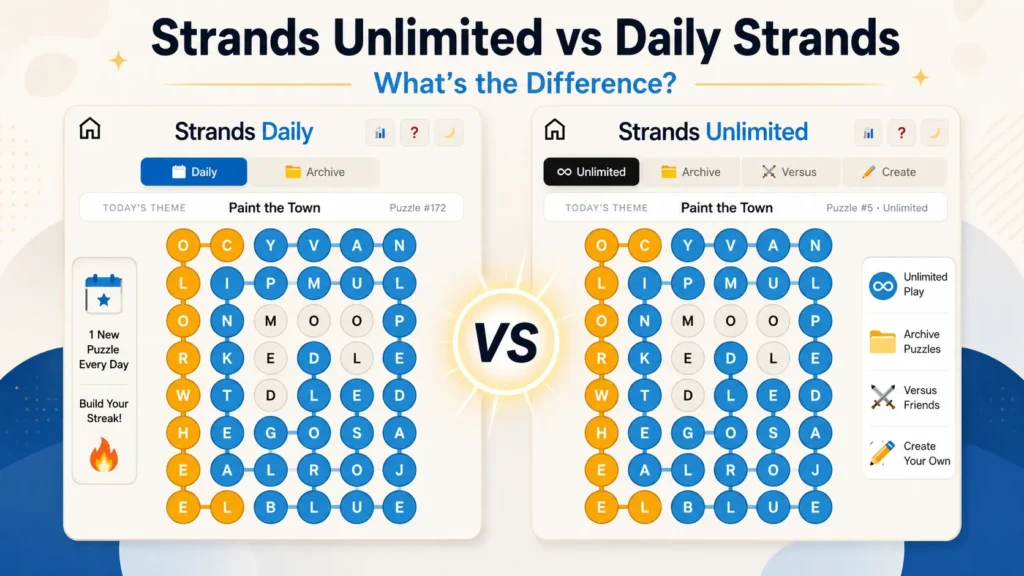
Strands Unlimited vs Daily Strands: What's the Difference?
If you’re searching for this comparison, you already know Strands exists — you just want to figure out which version fits how you actually play. The short answer: Daily Strands gives you one carefully-designed puzzle per day with a shared community experience, while Strands Unlimited gives you endless puzzles you can play back-to-back with no waiting. Both use the same core mechanics. The difference is pacing, pressure, and how much control you have over your own play session.Here’s what actually separates them, when each one makes sense, and how to decide which to open when you have 10 minutes and a word puzzle craving.
The Core Difference in One Paragraph
Daily Strands is the official New York Times version — one puzzle released each day at midnight local time, same for every player worldwide, tied to a global streak and stats system. Strands Unlimited is a free, independent alternative that removes the 24-hour wait. You can play unlimited puzzles in a single sitting, revisit past themes through an archive, create your own puzzles, and challenge friends head-to-head. Same mechanics — theme words, spangrams, hint system — different rhythm.
If you play word puzzles as a morning ritual, Daily Strands is built for you. If you play to relax, practice, or binge, Strands Unlimited is the better fit.
Head-to-Head Comparison
|
Feature |
Daily Strands (NYT) |
Strands Unlimited |
|
Puzzles per day |
1 |
Unlimited |
|
Cost |
Free (with NYT Games subscription for full access) |
Completely free |
|
Wait time between puzzles |
24 hours |
None |
|
Archive access |
Limited / subscription-based |
Full archive, free |
|
Custom puzzle creation |
No |
Yes |
|
Multiplayer / Versus mode |
No |
Yes |
|
Streak tracking |
Yes (global) |
Yes (local) |
|
Themes available |
New one daily |
30+ themed puzzles, rotating |
|
Sign-up required |
Yes (for stats/streak) |
No |
|
Community leaderboard |
Yes |
Limited |
|
Difficulty curve |
Editorially controlled |
Varies by mode |
|
Best for |
Daily ritual players |
Practice, casual play, binge sessions |
What Daily Strands Actually Gets Right
The New York Times Strands puzzle launched in March 2024 and quickly became one of the fastest-growing games in the NYT Games catalog. According to reporting from The Verge, it filled the gap between Wordle’s quick daily hit and Connections’ longer strategic play — a mid-length puzzle that could be finished on a coffee break but still felt satisfying.
The strengths of the daily version are real:
Editorial quality. Each puzzle is hand-designed by NYT puzzle editors. Themes are clever, spangrams are elegant, and the difficulty curves week-to-week in a way that keeps regular players engaged. You can feel the craft in a way that’s hard to match algorithmically.
Shared experience. When you finish today’s puzzle, so did millions of other people. That shared moment — the “did you get today’s spangram?” conversation — is a big part of why NYT Games work. It’s less about the puzzle and more about the ritual.
Streak psychology. The daily streak is a genuine motivator. Missing a day feels like breaking something, which is exactly the behavioral design NYT is going for. If you’re the kind of person who checks Duolingo out of guilt, Daily Strands works the same way.
The catch: you get one puzzle. That’s it. If you solve it in four minutes and want more, you have to wait until midnight. And if you want to replay old puzzles or explore themes you missed, most of the archive sits behind the NYT Games subscription ($6/month or bundled with a full NYT subscription).
What Strands Unlimited Does Differently
Strands Unlimited was built by independent developers to solve the “I want another one” problem. Same 8×6 grid, same theme-and-spangram structure, same hint-by-bonus-word system — but without the throttle.
Five play modes cover different moods:
Unlimited Mode. Endless themed puzzles, one after another. Finish, tap next, keep going.
Daily Puzzle. A single daily challenge inside the Unlimited platform, for players who want the ritual without the NYT paywall on the archive.
Archive Mode. All 30+ themed puzzles available anytime, free. Miss a day? Just open it.
Versus Mode. Real-time or asynchronous head-to-head play. Two players, same grid, fastest solve wins.
Custom Puzzle Creator. Build your own themed puzzle — pick the theme, spangram, and word list, then share the link. This is genuinely novel; the official version has nothing like it.
The trade-off is that Unlimited doesn’t have NYT-level editorial polish on every single puzzle. Community-created puzzles vary in quality, and the algorithmic puzzles in Unlimited Mode occasionally feel less curated than a hand-designed NYT theme. If puzzle craft matters more to you than puzzle quantity, that’s a real gap.
Who Should Play Which One
This isn’t a case where one version is objectively better. They’re built for different play patterns.
Play Daily Strands if you:
- Already have an NYT Games subscription or Wordle habit
- Want one puzzle a day as part of a morning routine
- Care about global streaks and shared experience
- Value editorial polish over quantity
- Enjoy the “wait for tomorrow” tension
Play Strands Unlimited if you:
- Get frustrated by the 24-hour wait between puzzles
- Want to practice and improve without daily limits
- Like variety — different modes, custom puzzles, versus play
- Don’t want to pay for the NYT archive
- Play in longer sessions rather than short daily bursts
- Want to create and share your own puzzles with friends
For most players, the honest answer is both. Play Daily Strands with your morning coffee for the ritual. Open Strands Unlimited on a weekend afternoon when you actually want to sink 30 minutes into puzzles. They complement each other more than they compete.
The Mechanics Are Identical (And That's the Point)
Both games use the same rules, which is what makes the comparison fair:
- 8×6 letter grid with a theme displayed above
- Theme words connect adjacent letters (horizontal, vertical, diagonal)
- Spangram is a special word that spans the entire grid and describes the theme
- Bonus words (5+ letter English words not in the theme) earn hints — three bonus words = one hint
- Hint system highlights letters of one unfound theme word
The gameplay loop is the same. What changes is the context around the puzzle — availability, pacing, and what happens after you finish.
This matters because it means switching between the two doesn’t require re-learning anything. Skills transfer directly. Practice in Unlimited Mode makes you faster at the Daily Strands. Finishing a tough Daily puzzle teaches patterns you’ll spot in Unlimited archive puzzles.
The Practice Argument
Here’s something the NYT version can’t really offer: structured practice.
If you want to get better at Strands — faster spangram spotting, sharper grid scanning, larger vocabulary of common theme categories — you need volume. One puzzle a day means it takes weeks to develop pattern recognition. In Strands Unlimited, you can play 10 puzzles in an hour and feel your scanning speed improve in real time.
Cognitive research on skill acquisition consistently shows that deliberate practice with frequent, varied repetition produces faster skill gains than spaced daily exposure. Puzzle games are no exception. If you’ve ever wondered why some players seem to breeze through the Daily Strands in under three minutes, chances are they’ve played the format enough — often through unlimited versions or archives — to internalize the patterns.
That’s not a knock on the daily version. It’s just that “one per day” is a ritual model, not a practice model. They serve different goals.
The Streak Question
For a lot of players, this comes down to the streak.
Daily Strands has a global streak — every day you solve the puzzle, the counter goes up. Miss a day and it resets. This creates a genuine behavioral hook, and for some players it’s the main reason they play at all.
Strands Unlimited also tracks streaks, but they’re local to the platform and less socially visible. There’s no “my friends see my streak broke” pressure. Which is either a plus or a minus depending on your relationship with gamified guilt.
Interestingly, a 2023 study on habit-tracking apps published inBehaviour & Information Technology found that streak-based systems boost short-term engagement but can create negative emotional associations when users feel forced to maintain them. If daily puzzle guilt is a thing for you, Unlimited’s more relaxed approach might actually be healthier.
Cost and Access
Daily Strands:
- The daily puzzle itself is free at nytimes.com/games/strands
- Full archive access requires NYT Games subscription (~$6/month) or full NYT subscription
- Available on web and NYT Games mobile app
- Requires NYT account for stats/streak
Strands Unlimited:
- Completely free, no subscription tiers
- No sign-up required for basic play
- Works in any modern browser on any device
- No app download needed
- Full archive access at no cost
For casual players who don’t want to add another subscription, the cost difference is meaningful. A year of NYT Games is ~$72. Strands Unlimited is $0.
When Each One Wins
Daily Strands wins when:
- You want the polished, editorially-curated experience
- Global community matters (talking about “today’s puzzle” with friends)
- You already pay for NYT Games
- You want short daily engagement, not long sessions
Strands Unlimited wins when:
- You want to play more than once a day
- You want to practice and improve quickly
- You want features like custom puzzles or versus mode
- You don’t want another subscription
- You want to replay old puzzles on demand
- You want to create puzzles for friends
Neither is trying to replace the other. They’re solving different problems for different players.
Frequently Asked Questions
Is Strands Unlimited affiliated with the New York Times? No. Strands Unlimited is an independent, fan-made game that uses similar mechanics but is not owned by, endorsed by, or affiliated with The New York Times or its NYT Strands puzzle.
Which version is harder — Daily Strands or Strands Unlimited? Daily Strands tends to have more consistent difficulty because it’s editorially designed. Strands Unlimited has a wider range — some puzzles are easier, some are harder — depending on the mode and whether they’re algorithmically generated or hand-curated.
Can I play past NYT Strands puzzles for free? Not officially through NYT. The full archive typically requires an NYT Games subscription. Strands Unlimited offers a free archive of past themed puzzles as an alternative.
Do the two games use the same words? No, the puzzles themselves are different. Both use the same format — theme, spangram, bonus words, hints — but the specific themes and word lists are independent.
Can I play Strands Unlimited on my phone? Yes. Strands Unlimited runs in any modern mobile browser without needing to download an app. It works on iOS, Android, and tablets.
Does using Strands Unlimited count toward my NYT Strands streak? No. The two platforms track streaks separately. Playing Strands Unlimited does not affect your NYT Games streak, and vice versa.
The choice between Daily Strands and Strands Unlimited isn’t really about which is better — it’s about what you want from a word puzzle. If you want a ritual, the daily version is designed for that. If you want a practice ground, an archive, a place to create and share puzzles with friends, or just more than one puzzle a day, the unlimited version is built for that.
Most serious word puzzle fans end up using both. Daily Strands in the morning, Unlimited when the craving hits again in the afternoon. They’re not competitors — they’re two different ways to enjoy the same core idea, and having both makes the whole hobby better.
Try it yourself: open Strands Unlimited in one tab and today’s NYT Strands in another. Play both back to back. You’ll feel the difference within five minutes — and probably know exactly which one fits how you actually play.