How to Play Strands: Rules, Theme Words, Spangram, and Hints
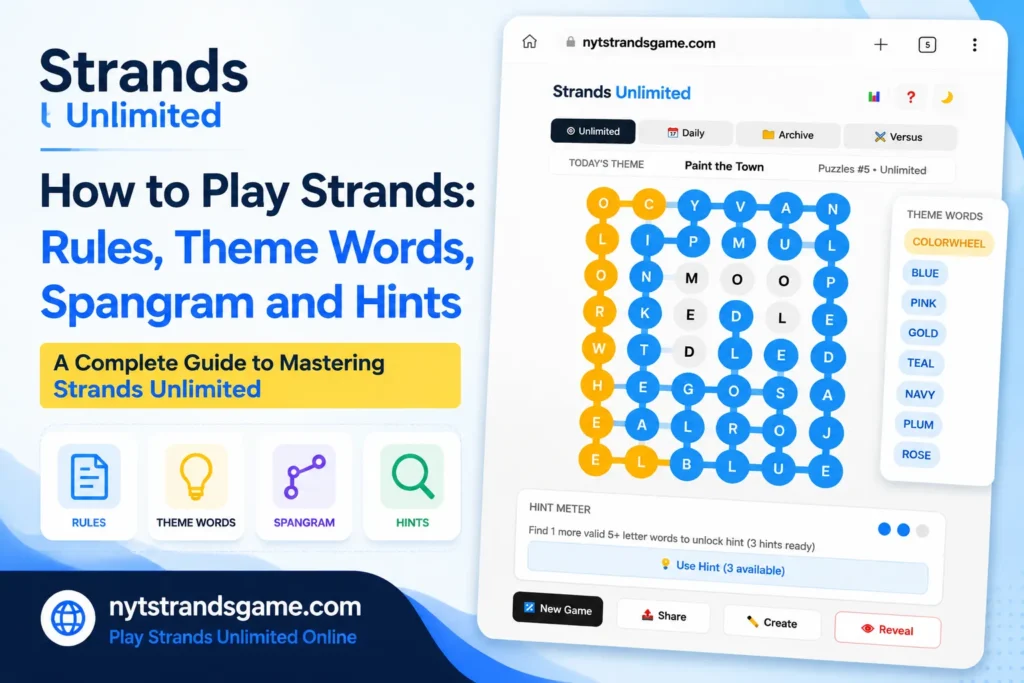
If you’re new to Strands, here’s what you actually need to know: Strands is a themed word puzzle played on a 6×8 grid where you connect adjacent letters to find hidden theme words and one special word called the spangram. Every letter on the board belongs to a valid answer, and you can earn hints by finding bonus words that aren’t part of the theme.
That’s the whole game in one paragraph. Everything else is refinement. This guide covers the exact rules, what makes theme words and the spangram different, how the hint system actually works, and the small habits that separate players who finish puzzles in five minutes from players who stall for twenty.
The rules described here follow the official New York Times Strands help documentation and the NYT Games team’s launch coverage of Strands in March 2024.
| Element | Rule |
|---|---|
| Board size | 6 rows × 8 columns = 48 letters |
| Letter usage | Every letter is used exactly once |
| Movement | Connect adjacent letters (horizontal, vertical, diagonal) |
| Direction changes | Allowed mid-word |
| Theme words | Highlighted in blue when found |
| Spangram | One special answer, highlighted in yellow, touches two opposite sides |
| Hints | Earned by finding 3 non-theme (bonus) words |
| Word overlap | Theme words never overlap on the board |
| Puzzle completion | Requires finding all theme words plus the spangram |
Those nine rules cover the entire mechanical layer. Everything below explains how they connect and how to use them.
What Strands Actually Is (And Isn't)
Strands looks like a word search, but it doesn’t behave like one.
In a traditional word search, you’re given a list of words to find. The words usually run in straight lines, and most of the letters on the board are filler — decorative noise designed to make the target words harder to spot.
Strands rejects both of those conventions. You’re not given a word list. You’re given a theme, and you have to figure out what words fit. There’s no filler. Every letter on the board belongs to a real answer, which means finding one word actively reduces the possibilities for the rest. And the words don’t have to run straight — you can bend the path, turn diagonally, and change direction as long as each letter connects to the next.
That combination — themed vocabulary, full-board coverage, flexible paths — is what makes Strands feel different from anything that came before it. The New York Times editorial team described it as a puzzle that blends word search mechanics with the theme-driven satisfaction of a crossword.
Rule 1: Read the Theme Before You Touch the Grid
Every Strands puzzle displays a theme at the top of the board. It might be a category (“Under the Sea”), a phrase (“Look Up!”), or a wordplay clue (“Sweet Dreams”). New players glance at it and immediately start scanning letters. That’s the single biggest cause of early frustration.
The theme isn’t decoration. It’s the mental framework you need before scanning letters becomes efficient. When you know the puzzle is about marine life, your brain pre-loads words like coral, tide, shark, wave, reef — and suddenly you’re not parsing 48 random letters, you’re checking whether those specific letter patterns exist on the board.
The NYT’s official Strands tips article explicitly recommends starting with the theme clue and thinking about its layered meanings. Some themes are literal; others involve puns, phrases, or category twists. Either way, giving the theme 20 seconds of thought before scanning saves several minutes of confused searching later.
Practical habit: After reading the theme, mentally list five words that could fit. Then scan the grid with those specific letter patterns in mind.
Rule 2: Understand How Letters Connect
Letters in a valid Strands word must be adjacent to each other. Adjacent means directly touching in any of eight possible directions:
- Left, right, up, down
- Any of the four diagonals
You can also change direction within a word. That means a word doesn’t have to travel in a straight line — it can zigzag across the grid as long as every letter touches the one before it.
This flexibility matters more than most beginners realize. A five-letter word doesn’t need five letters in a row. It can start in one corner, bend twice, and end four squares away. That’s why paths sometimes look surprising when the game reveals them.
Practical habit: Before you drag a word, trace the path with your eyes first. Confirm each letter genuinely touches the next. Broken traces waste more time than any other rookie mistake.
Rule 3: Every Letter Belongs to a Solved Word
This is the rule that changes everything about how you scan the board.
The official NYT rules state that the board must be filled entirely to complete the puzzle — no letters are left over, and theme words never overlap. Every one of the 48 letters ends up as part of the spangram or a theme word.
The consequence is that finding words actively reduces the possibilities for the rest of the board. Once you find a five-letter theme word, those five letters are gone from the map of unsolved territory. That’s why experienced players tend to accelerate in the second half of a puzzle — the search space keeps shrinking with every discovery.
For beginners, the practical takeaway is this: don’t get stuck staring at the whole grid at once. As you solve, mentally cross off the letters you’ve used. What’s left is a much smaller, more manageable problem.
Rule 4: The Spangram Is the Master Key
Every puzzle has exactly one spangram, and it’s the most important answer on the board.
The official rules define the spangram as a challenge word that touches two opposite sides of the grid. When you find it, it highlights in yellow (theme words highlight in blue), signaling that you’ve located the puzzle’s anchor. The spangram doesn’t just fit the theme — it describes it.
If the theme is “Under the Sea” and the spangram is CORALREEF, you now know the puzzle is specifically about reef ecosystems, not general ocean creatures. That specificity narrows your search for the remaining theme words dramatically. If the theme is a phrase like “Look Up!” and the spangram is CONSTELLATION, you know the puzzle is about star patterns, not weather or aviation.
Why finding the spangram early matters:
- It confirms the theme’s exact angle
- It removes a large block of letters from the search space
- It gives the remaining theme words a clearer semantic direction
- It builds momentum — the rest of the puzzle usually feels easier afterward
The NYT even tracks a stat called “Spangram First” — puzzles completed where the spangram was your very first word. That’s how much the game itself values the spangram-first approach.
Practical habit: Before hunting individual theme words, spend 60 seconds trying to trace a path from one edge of the grid to the opposite edge. Long letter runs that could form an 8+ letter word are strong spangram candidates.
Rule 5: Bonus Words Unlock Hints
If you find a valid English word of 5+ letters that isn’t part of the theme, the game counts it as a bonus word (sometimes called a non-theme word). Every three bonus words earns you one hint.
The official documentation confirms this exact ratio: three non-theme words = one hint unlocked. Bonus words don’t complete the puzzle — they exist purely as a way to earn assistance without breaking the challenge.
That design choice matters. It means the hint system isn’t a “give up” button. It’s a reward for active exploration. Players who scan the grid carefully find bonus words naturally and end up with more hints available when they actually need them.
Common patterns for bonus words:
- Simple 5-letter English words: HOUSE, TRAIN, PLANT, WATER, STONE
- Words ending in common suffixes: -ING, -ED, -ER, -LY
- Words starting with common prefixes: UN-, RE-, PRE-, DIS-
Bonus words often hide near the edges and corners of the grid, where theme paths are less likely to run. If you’re stuck on theme words, switching to bonus-word hunting for 60 seconds is a productive detour — it earns you a hint and often reveals theme-word letters you’d been overlooking.
Rule 6: Hints Highlight Letters, Not Paths
When you use a hint, the game highlights the letters that make up one unfound theme word. It does not draw the connection path. You still have to figure out how the letters connect and drag the word yourself.
This distinction matters because it preserves the puzzle-solving experience. A hint gives you a nudge — it doesn’t finish the word for you. You still get the satisfaction of tracing the correct path, even when the game has narrowed which letters to focus on.
If you’re completely stuck on a single word, using a second hint on that same word will reveal the full solution path. But most players find that a single hint is enough to jog their brain into spotting the correct connection.
When to use a hint:
- You’ve been stuck on the grid for more than 3–4 minutes with no progress
- You’ve already found several theme words and are down to the last one or two
- The vocabulary of the puzzle is outside your comfort zone
When to hold off:
- You’ve only just started the puzzle
- You haven’t scanned the edges yet
- You’re close to earning another hint anyway (1–2 bonus words away)
The First-Minute Playbook
Here’s what a good opening looks like, put together from the rules above:
Seconds 0–20: Read the theme. Say five related words in your head. Don’t touch the grid yet.
Seconds 20–80: Try to find the spangram. Scan for long paths that go from one edge to the opposite edge. If you find it, place it. If not, remember your best candidates.
Seconds 80–140: Look for bonus words in the corners and outer rows. Even one or two moves you closer to a hint.
Seconds 140+: Hunt theme words, starting with the longest ones you can spot. Trace with your eyes before dragging.
This structured start feels slower than random scanning at first, but it consistently produces faster overall solve times. Deliberate play beats reactive play in puzzles the same way it does in most cognitive tasks — a principle backed by decades of research on expert performance in structured problem-solving.
What Makes a Word “Valid” in Strands
A few edge cases confuse new players:
Words must be at least 4 letters long to register as any kind of answer. Three-letter words won’t be accepted.
Bonus words must be at least 5 letters to count toward hints. A valid 4-letter word that isn’t part of the theme won’t unlock hint progress.
Words must be recognized English words. Proper nouns, abbreviations, and slang generally won’t work. If you try a word and nothing happens, it’s not in the game’s dictionary.
Words don’t have to appear in order on the board. Because you can bend paths, a word’s letters can travel in any direction as long as each is adjacent to the next.
Every letter must be used exactly once per word. You can’t revisit a letter within the same word.
Common Beginner Mistakes (And Quick Fixes)
Mistake: Diving into the grid without reading the theme. Fix: Take 20 seconds to think about what the theme means before you scan.
Mistake: Searching for random short words. Fix: Look for the spangram first, then long theme words.
Mistake: Spending a hint in the first two minutes. Fix: Wait until you’ve found at least three theme words on your own.
Mistake: Ignoring bonus words. Fix: Deliberately scan corners for 5+ letter non-theme words to earn hints.
Mistake: Rushing the connection drag before eye-tracing the path. Fix: Verify each letter is adjacent before you start dragging.
Mistake: Quitting when stuck. Fix: Take a 30-second break, then re-scan the edges. Fresh eyes usually spot what tired eyes missed.
How Strands Compares to Similar Games
To put the rules in context, it helps to see how Strands relates to nearby puzzle formats:
| Feature | Strands | Traditional Word Search | Wordle |
|---|---|---|---|
| Grid size | 6×8 | Varies (usually larger) | 5×6 guess grid |
| Word list given | No — theme only | Yes | No — one target word |
| Filler letters | None (every letter used) | Yes | N/A |
| Direction changes | Yes | No | N/A |
| Special word | Yes (spangram) | No | The daily answer |
| Hint system | Earned via bonus words | Usually none | Color feedback per guess |
| Typical solve time | 10–15 minutes | 5–20 minutes | 2–5 minutes |
The takeaway: Strands sits between a traditional word search and a themed puzzle like a crossword. It’s more interpretive than a word search, more visual than a crossword, and more sustained than Wordle.
FAQs
How long is a typical Strands puzzle? Most players complete a Strands puzzle in 10–15 minutes. New players sometimes take 20–30 minutes on their first few puzzles. Solve time drops noticeably after 15–20 sessions as pattern recognition improves.
What’s the difference between a theme word and the spangram? Theme words are regular answers that fit the puzzle’s theme; they highlight in blue when found. The spangram is one special word that touches two opposite sides of the board and describes the theme itself; it highlights in yellow when found. Every puzzle has multiple theme words but only one spangram.
How do I earn hints in Strands? By finding non-theme words of at least 5 letters. Every three bonus words unlocks one hint. Hints then highlight the letters of one unfound theme word to help you solve it.
Can I play Strands without a New York Times subscription? Yes. The daily Strands puzzle is currently free on all NYT platforms. Full archive access requires an NYT Games subscription, but free alternatives like Strands Unlimited offer unlimited puzzles, archives, and custom puzzle creation at no cost.
Do I need to find every word to complete the puzzle? Yes. To finish a Strands puzzle, you must find all theme words plus the spangram. Bonus words are optional — they only earn hints, not completion credit.
What happens if I can’t finish a puzzle? There’s no fail state in Strands the way there is in Wordle. You can keep playing until you find every word, using hints when needed. In the daily version, unfinished puzzles will lower your solve percentage stat but won’t reset your streak unless the next day begins.
Strands is one of those puzzles where the rules are simple but the strategy has real depth. The mechanics fit in a paragraph — read the theme, connect adjacent letters, find the spangram and theme words, earn hints through bonus words. The skill is in the sequence: which words to hunt first, when to spend hints, when to reset your eyes and look again.
If you want to actually get good, don’t just play one puzzle a day. Play several in a row on a platform like Strands Unlimited, where you can practice the full loop back-to-back until the patterns become automatic. A week of that will do more for your solve time than months of daily play.
Open your next puzzle, read the theme twice, and start looking for the spangram before anything else. That’s the whole game — the rest is refinement.